
NOTE: This news story is for information purposes only and does not constitute an offer to sell or a solicitation of an offer to buy any securities. Prospective investors should read the full Prospectus carefully and may consult a professional advisor.
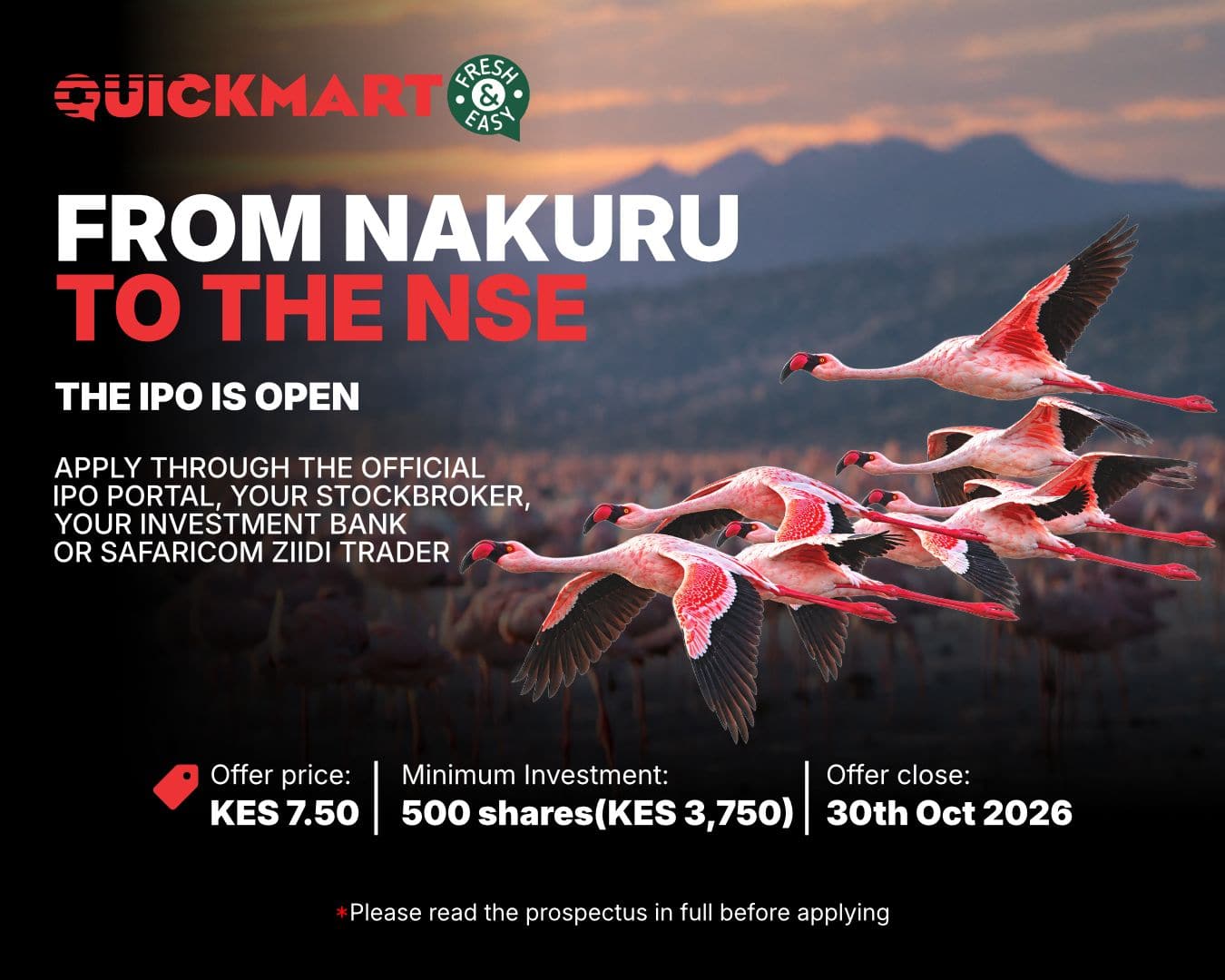
Kenyan convenience shop chain Quickmart is open for sale through an initial public offering (IPO) on the Nairobi Securities Exchange. The share offer – 2 billion ordinary shares at KES 7.50 ($0.05) each, for a total capital raise of KES 15bn ($115.6 million) – will close on 30 October.
Quick Mart PLC is currently owned 100% by Mauritius-registered Sokoni Retail Kenya Limited, which is offering 50% its shares for sale. No new shares are being issued. The Quickmart IPO page is here.
Sokoni is owned by four shareholders, a company called Sokoni Retail Holdings, the vehicle of private equity firm Adenia Partners (50.8%), the founders of Quickmart (32.8%), the founders of Tumaini supermarkets (12.0%) and Group CEO Peter Kang’iri (5.4%). The share sale will enable these shareholders to take returns on their investments. Sokoni is locked in and cannot sell more shares for 24 months after the IPO. The authorised and fully paid share capital is 4bn shares with nominal value KES 0.20 each.
The lead transaction advisors are SBG Securities and Stanbic Bank, with SBG Securities as sponsoring broker and lead placing agent, Stanbic as receiving bank and Dyer & Blair Investment Bank as co-placing agent.
The company aims to list on the NSE’s Main Investment Market Segment on 12 November, although this date may change. The offer opened on 5 October after it was approved by the Capital Market Authority of Kenya. It will only go ahead if valid applications are received for at least 75% of the offer shares by the closing date. The IPO is not underwritten.
It is the second major IPO on the NSE since 2015, when the exchange demutualized and listed itself, according to this story in African Business. Kenya Pipeline Company listed in March 2026 (see ACMN article on the IPO) after the Government sold a 65% stake to raise KES 106.3bn ($823m), according to this Reuters story.
Quickmart – 20 years of growth
Quickmart operates 72 modern retail grocery shops in urban and suburban locations in 16 of Kenya’s 47 counties (as at end August 2026). There are 54.2m Kenyans, including 18m urban consumers.
The Information Memorandum says Quickmart is the second largest supermarket network in Kenya, operating leased stores which are hypermarkets, supermarkets and express stores. They sell food including fresh food (65% of revenue), home and personal care, liquor, electronics, household goods and textiles.
At 30 June it employed 1,906 direct employees and 6,068 other staff. It runs its own training programmes including Quickmart Retail Academy. It has an Environmental and Social Management System and is aligned to international good practice standards, including the IFC Performance Standards.
According to the information memorandum, the projected 2026 earnings (adjusted earnings before interest, tax, depreciation and amortization EBITDA will be KES 6.6bn and adjusted net income will be KES 2.3bn, giving an implied price/earnings (adjusted earnings) ratio of 12.9x. Historic profitability and dividend distributions for the last five and a half years (half year to June 2026) are on page 41 of the Information Memorandum. The offer announcement can be found here.
Private equity growth boost
Quickmart was originally set up in Nakuru in 2006 by the late John Kinuthia and his son, Duncan.
Private equity fund Adenia Partners invested in 2019, when Quickmart had grown to 10 shops, and acquired 51% controlling interest. The year before, Adenia had acquired 55% in another supermarket chain, Tumaini, also set up in 2006 in Nairobi’s Eastlands by Moses Nditika, Joram Ngeruro and Elijah Okello. Adenia orchestrated the merger in December 2019. Adenia also supported capacity development of the management and introducing more structured operating, financial and governance framework. The shareholders of Tumaini and Quickmart swapped their shares for holdings in Sokoni and the two businesses merged effective 1 January 2020.
Since then, expansion has been rapid, adding 10 shops a year in 2020-2022 and reading 64 shops by end of 2025. It has set up a loyalty programme in 2021, its own e-commerce platform in 2024 and partnerships with third party platforms Glovo, Uber Eats and Bolt.
Martha Osier, a partner at Adenia, told African Business (article by Lennox Yieke), that the IPO is a partial exit and it will remain the largest shareholder: “What is different about Adenia is that we only invest if we can get a controlling equity stake. We do not take minority stakes.”
“When Adenia invested in Quickmart, what we liked about the company was that it had carved a niche in the convenience sector, and especially neighbourhood convenience. Quickmart is different in that it’s not in the big malls.”
Adenia Partners, founded in 2002, has raised $1.1bn across six funds, and has over 30 investments, supporting over 19,000 jobs ,It is based in Mauritius and has seven local offices. It invests in medium-sized companies to create regional champions.
Offer mechanics
Every applicant must hold a valid account at Kenya’s central depository system (CDS), operated by Central Depository and Settlement Corporation Limited. Applicants can submit electronic applications, including by mobile phone subject to a maximum application of KES 250,000 ($1,927), as outlined in the offer announcement. They can also fill in applications and take them to the placing agents in time for the deadline. The minimum application is 500 shares.
The aim is to achieve a balance between domestic and international investors, with a target allocation of: 20% to Kenyan retail investors, 35% to Kenyan institutions, 12% to investors form the East African Community, 20% to foreign investors and 13% to the IFC as cornerstone investor. Costs and expenses of the offer are listed as KES 575.6m (3.8% of the gross offer proceeds) and paid by the selling shareholder.
Going forward, the Board has committed to paying at least 80% of annual profits out as dividends.
The NSE All-Share Index (NSE ASI) is up 31% year-to-date in 2026 after climbing 51% in 2025 and 34% in 2024. Adenia’s Osier commented “The stock market is currently experiencing a strong bull run. We felt that this would be a good time to come to the market because there’s a lot of uptake for equities, which had not necessarily been the case before. With treasury bill rates down to 8-10% from historically highs of 16%, equities are attracting renewed interest.”
IFC’s anchoring IPOs
The International Finance Corporation has committed to buy up to $15m (approximately KES 1.94bn) in shares in the IPO (about 13% of the offer) at the offer price and on the same conditions as other shareholders. It will be a 6.5% shareholder after the offer, . IFC’s participation is subject to approval from its board.
According to this article in Business Day Nigeria by Faith Omoboye, citing Kenya’s Business Daily, the IFC Is increasing its participation in major African capital market transactions. It is also investing $90m in Airtel Money’s IPO on the London Stock Exchange. Omoboye writes: “The two transactions point to IFC’s growing use of cornerstone investments to gain exposure to large African equity offerings while providing companies with institutional backing as they raise capital.”