
Airtel Money has announced its plans to list via initial public offering (IPO) on the London Stock Exchange that could raise at least $800 million. It is a strategic boost to the London market, where regulators and policymakers have introduced reforms to make listings more attractive but the LSE had been struggling to gain momentum.
Airtel Mobile Commerce MV has filed paperwork for the IPO on 23 September and the prospectus is expected in early October and the pricing to come in mid-October after a book build, according to this report by Herald Aloo in The Africa Report. According to this article by Kieran Smith in the Financial Times, the company was reported to be aiming for a valuation of $8 billion to $9bn.
The choice of London is partly a follow on from the successful listing of parent company Airtel Africa, which listed in June 2019 and raised £593m ($750m) with an IPO (see ACMN article here), and the shares have nearly quadrupled in price since then. According to the FT, CEO Ian Ferrao said London investors had a “good understanding” of emerging markets and deep pools of capital.
Airtel Africa, itself formed in 2010 and still majority owned by India’s Bharti Airtel, owns 78% of the shares in Airtel Money. Other investors are TPG, Mastercard, the Qatar Investment Authority and Chimetech Holding who acquired minority stakes in 2021, paying a total of $550m. The IPO is a secondary share sale, meaning that existing shareholders are selling shares and it is likely that this could be a partial exit for some.
The International Finance Corporation has been investing strongly in telecommunications in Africa and has agreed to buy $90m of shares at the final offer price.
Airtel Money said on Wednesday the free float on the London exchange would be at least 10% and Airtel Africa parent would remain a “long-term strategic shareholder”.
Citi is leading the transaction as sole sponsor, global coordinator and joint bookrunner and Barclays, BofA Securities, Goldman Sachs and JPMorgan are joint global coordinators and joint bookrunners. Absa, BNP Paribas, Emirates NBD Capital, First Abu Dhabi Bank, Jefferies and Standard Bank have been appointed joint bookrunners, BTIG is co-bookrunner and RetailBook will coordinate the UK retail offer, according to The Africa Report.
Airtel Money has 53m mobile money users
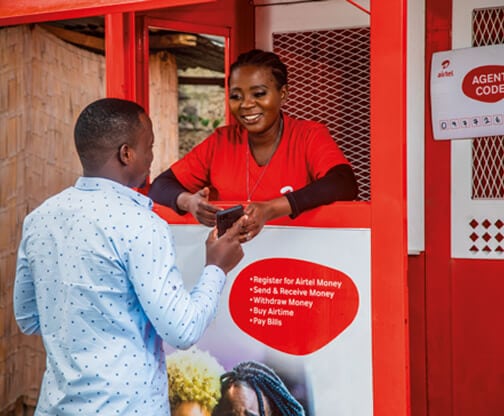
Airtel Money reports 53m mobile money users across 13 different markets in June 2026, up from 44.3m the previous June. The users use mobile money to deposit and withdraw cash at kiosks and branches (43 outlets) and 2.3m agents and to pay utility and other bills and transfer funds or take out microloans. Total value processed in the year was $213bn. The key region is East Africa but it also has strong operations in Nigeria and French-speaking Africa.
Reported revenues were $1.35bn in the last financial year to 31 March 2026, up 62% in the past two years. According to the Africa Report, operating free cash flow for the year was $638m, and earnings before interest, tax, depreciation and amortization (EBITDA) was $676m. Net income was $373m to March 2026, up from $304m for the previous year. The company said underlying margin is some 50% and pre-tax cash conversion was over 90% in each of the last three financial years.
Ferrao commented that it is a secondary share sale because of Airtel Money’s financial strength: “The business is debt-free, capital-light and highly cash generative, which is why this offer consists solely of shares sold by existing shareholders and no new capital is being raised.”
He added: “A London listing will underpin our next wave of growth,” providing a platform for future transactions. He pointed to rising digital transactions and forecast fivefold growth in volumes by 2031. In the shorter term, there is growth potential as Airtel Africa has 128.9m telecom subscribers, leaving 75m who do not yet have Airtel Money accounts.
Why pick London Stock Exchange for an IPO?
The company has its legal headquarters in the Netherlands and a strategic office in Dubai. It had first considered listing in the Middle East, but the US-Israel war on Iran and regional uncertainty made it look further afield, including at European exchanges. The London listing has been mooted and delayed and the targeted capital raise is about half what was expected earlier in the year.
Airtel Africa listed in London in June 2019 and on the Nigerian Exchange (NGX) in July 2019, with a listing worth NGN 1.36 trillion ($4.4bn).
Ferrao told Reuters: “When it comes down to it, London has deep capital available … Our brand is well known, and that’s probably made it easier for us to walk into London and to talk to all of the investors. We believe in London and I think it’s going to be a good home for us.”
Ferrao told Simon Hunt of City AM he “evaluated lots of exchanges” across Europe, North America and the Middle East over several months before settling on London: “There is clearly deep capital available in the London markets, and that’s apparent from all the investor outreach we’ve done. All the global institutions, long-only funds, and big hedge funds sit here in London, giving access to global investors.”
“Second, there is a very good understanding of emerging markets, specifically financial services, fintech, and technology platforms. I found a deep understanding of our business and dynamics here.”
London’s listing reforms aim to win local and global listings
The UK Government and the Financial Conduct Authority have rolled out drastic reforms aiming to encourage businesses to list in London. According to Sarah Pritchard, FCA executive director of markets and international, the new listing rules became operational in July 2024: “.. moving towards a more disclosure-based regime, which puts the right information in the hands of investors so they can make their own decisions.”
Although IPOs were already exempt from the UK’s 0.5% stamp duty reserve tax, in November 2025 then-Chancellor Rachel Reeves announced that UK Listing Relief from stamp duty for secondary market trades in newly listed companies would last three years.
In December 2021 the FCA implemented a rule change to reduce the free float requirements from 25% to 10%, so business owners could keep more of their share stakes.
On 5 August 2026, the FCA announced more rule changes they say will “reduce execution risk for issuers, lower compliance costs and make it easier for companies to access public markets. As part of the changes, the FCA will remove the 7-day waiting period for connected research during an IPO and simplify information-sharing requirements for issuers and firms.”. It adds this will “support the FCA’s aim of enabling growth, investment and innovation, while continuing to uphold high standards of market integrity and investor protection.”
Jon Relleen, FCA director of infrastructure and exchanges, said: “By making the UK listing regime more efficient, we are supporting the growth and competitiveness of UK capital markets.”
Listing pipeline strong for London SE
Previous large listings in London included:
- Wise – the British fintech (formerly Transferwise) was valued at £8bn ($11bn) when trading opened in July 2021, although it has since moved its primary listing to Nasdaq in May 2026, retaining a secondary listing in London.
- Haleon – GSHK spun off this consumer health company in July 2022 and listed it at valuation of about £31bn ($41bn) although it fell in early trading. The listing was for the existing shares which had been distributed to GSK shareholders.
- Magnum Ice Cream Company – Unilever spun this company off in December 2025 with a listing on Euronext Amsterdam and secondary listings in London and New York and a valuation of EUR 7.8bn ($9.1bn).
In 2021 there were 37 tech and consumer IPOs which raised £6.6bn. There were 23 IPOs on the LSE in 2025 for a total raised of £2.13bn ($2.8bn), double the total in 2024.
According to a report on Bloomberg, IPOs in London picked up in October 2025, with three large IPOs in the last three months of the year: Princes Group Plc ($539m), Shawbrook Group Plc bank ($531m) and buyout company Mayflower Acquisition Ltd ($500m).
Reports cite data from the LSE indicating only seven listings so far in 2026, raising a total of £577m ($764m). Bloomberg says the listing of Uzbek national investment fund UzNIF made up most of this (it raised $600m in an IPO). On 18 September Softcat PLC said it raised £354m ($468m) in equity to help fund the $1.05bn acquisition of GDT Topco LP in the US.
On the other hand, several buyers of leading UK companies have taken them private. In addition, listings delayed or cancelled in 2026 include:
- Loveholidays – travel agents in March delayed a $1.3bn IPO due to Gulf travel chaos and market turmoil.
- Visma – a software group delayed its listing after software stocks fell in the “SaaSpocalypse” where investors feared rollout of artificial intelligence (AI) would damage earnings. Simon Hunt in CityAM said it would have been valued at £15bn ($20bn).
- RAC – roadside recovery for stranded motorists had decided on a private sale instead of a £5bn ($6.6bn) London IPO.
- Waterstones – the bookshop has postponed to 2027.
According to Pablo Mayo Cerqueiro in Bloomberg, companies from around the world are considering listings in London: “Among them are Spanish miner Abenojar Tungsten, Taiwanese conglomerate TCC Group Holdings Co. and Uzbek logistics firm Centrum.”
UK-based wealth manager Utmost Group Plc is also considering coming to market with an IPO during 2026. Another potential listing is the European arm of TCC, formerly Taiwan Cement.
This report by Graeme Evans for Interactive Investor cites investment bank and stockbroker Peel Hunt said: “In our view, the considerable body of regulatory reform by the FCA, LSE, and the government transforms the attractiveness of London as a listing venue. We expect companies to become increasingly proactive in using the market to accelerate investment and growth through acquisitions.”
It added that the UK’s geopolitics meant firms were increasingly looking to 2027 for their debuts: “The UK IPO pipeline remains the strongest it has been since 2021.”
4 responses
Hello Dear assistant and help me to register and start the business with you,on the liste. My name is Patrick Lukengo and I am in africa, Democratic Republic of congo/kinshasa. What is your orientation for me? Thank you.
Patrick
Hi Patrick, thank-you for getting in touch. We are only a news source and we cannot help people access share offers. I have also edited out your email address from your comment before publishing for security. We urge people using our website to be very careful about security.
With regard to the Airtel Money IPO, you will need to wait until the prospectus is published, you can follow the Airtel Money investor relations page and other sources.
Best wishes
Tom