

UPDATE 20/2/26 – The share offer has been extended by 3 days and will close on 24 February. Reuters news reports that the Capital Markets Authority announced the extension. Other aspects of the offer do not change. Local media have been reporting that investors are concerned about the valuation (see update below). The IPO needs 250 applicants and applications for 50% of the shares (KES 53.1bn) to proceed. According to a report in Business Daily brokers suggested the offer was only about 20% subscribed by 17 February. The Privatization Authority said that retail investors had been pushing for the time extension.
(NOTE: This post is for news information only and does not constitute investment advice in any form)
Kenya’s Government has launched the sale of a 65% stake in the state-owned Kenya Pipeline Company (KPC) in what is expected to be East Africa’s largest initial public offering (IPO) measured in local currency. The capital-raising share offer aims to raise KES 106.3 billion ($825 million).
The offer opened on 19 January and closes at 5pm on 19 February. The share price has been set at KES 9 each (nominal value KES 0.02 each), with over 11.8bn shares on sale. KPC aims to list on the Nairobi Securities Exchange on 9 March and share trading is to start the same day. There has been significant debate in the Kenyan media on the valuation, for sample articles see this article on local financial and investment advisory firm Abojani and search online for many other informative articles (some argue that the Government is seeking a high valuation and there could be risks, and highlight alternative opportunities).
Update 20/2/26 Here are some of the valuations, compiled by Harry Njuguna of The Kenyan Wall Street.
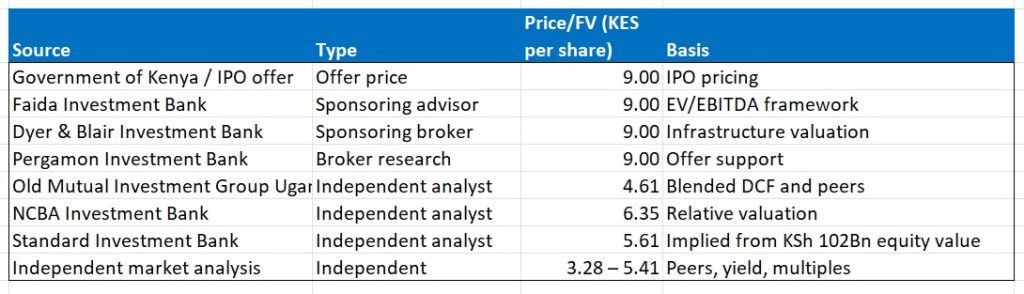
Faida Investment Bank is the lead transaction adviser, lead sponsoring broker is Dyer & Blair Investment Bank and co-sponsoring broker is Francis Drummond & Co. The Information Memorandum can be found here, and there is a succinct summary on the African Markets website.
The Government is aiming for strong response from retail investors and hopes that the strategic importance of the company will draw in institutional investors and key stakeholders, particularly those focused on the energy sector.
If the offer is fully subscribed the allocation will be to five pools with the following target breakdown:
- 45% of the offer shares to Kenyan investors (individuals and institutions) made up of 20% to individuals, 20% institutions, 5% to KPC employees
- 20% to East African investors
- 15% to oil-marketing companies – 146 OMCs are registered although the top 10 account for 72% of the market
- 20% to foreign investors
- Government retains 35% of the total shares.
KPC is the state-owned firm responsible for transporting, storing and distributing petroleum products in Kenya and it is strategic to energy security. It is a monopoly with an extensive pipeline network linking Mombasa port to major consumption centres across Kenya country, including Nairobi and western Kenya. It also transports to five East African countries, with Uganda accounting for 65% of the oil moving up the pipeline followed by eastern DRC, South Sudan, Burundi and Rwanda, according to the Africa Report. The report also says that Uganda has bene offered 40% of the shares in the offer.
According to John Mbadi, Cabinet Secretary, National Treasury and Economic Planning: “KPC is one of the most profitable companies that is wholly owned by GoK, and in this way, has contributed significantly to the country’s budget. KPC recorded revenues of KES 38.59bn and after-tax profits of KES 7.49bn for the year ended 30 June 2025. The company is financially sound and supported by a strong resilient balance sheet.”
The IM reports that dividend per share for the year to 30 June 0225 was equivalent to KES 0.347 and the future policy will be a dividend payout reduced to 50% compared to previous dividends. The 2025 earnings per share (EPS) was equivalent to KS 0.4122. Reported earnings before interest, tax, depreciation and amortization (EBITDA) was KES 18.6bn, giving an implied Enterprise Value/ EBITBA multiple of 8.1x.
The Information Memorandum says the Government’s divestiture policy aims to support a broader fiscal strategy, advance capital markets development and to align with a national reform agenda for state-owned enterprises. The Government currently uses 40% of its revenue for debt repayments and interest and has limited room to raise tax, according to Reuters.
The funds generated from the giant IPO will go to Government to capitalize an infrastructure fund for planned giant projects. It is part of President William Ruto’s strategy to reduce state ownership in public enterprises. In December 2025 the Government sold a 15% stake in Safaricom to Vodacom of South Africa to raise about $1.6bn. See our previous story on Kenya’s new infrastructure and sovereign wealth funds.
KPC aims to triple its five-year capital spent to KES 110bn ($853m) and will raise the financing through “a combination of internally generated cash flows and innovative financing structures including access to debt capital markets, special purpose vehicle project financing, joint ventures and partnerships,” according to the listing document, as reported by Bloomberg. Projects include a new pipeline from Eldoret to Kampala in Uganda and then to Rwanda. KPC will build an oil trading hub in Mombasa and additional storage for the national strategic petroleum reserves.
In 2008, The Government raised just over KES 50bn when it sold shares in telecoms company Safaricom, making it the previous largest IPO, measured in local currency. Since then the Kenyan shilling has depreciated against the USD so the historic Safaricom IPO is still larger than the current KPC IPO when measured in equivalent US dollars.
13 responses
its quite impressive to sell a high percentage of the KPLC
Yes, its an interesting strategic move by the Government. I am happy there is such a high level of discussion of investment opportunities now on social media, particularly on LinkedIn. It makes a great chance for all of us to learn more! Thanks for your comment and good luck with your investments.
looks lucrative. worth buying.
Hi Edward, spend some time looking at the discussions on valuation and get some advice from a professional advisor or stockbroker before taking the plunge whether you are new or an expert investor. Good luck in your investment journey.
how can I by the shares?
Hi Kelvin,
Sorry for the delay in replying. I hope that you were successful in applying.
The Kenya Pipeline Company shares are currently listed for trading on the Nairobi Securities Exchange. That means that you can buy at the prevailing price, which is not much higher than the offer price, I think they are currently about KES 9.12 each. You can contact a stockbroking member on the NSE if you wish to buy or sell any shares on the exchange.
You can also use the Ziidi Trader app, see our story.
Best wishes, Tom
no coment