
Effect of Hormuz
How badly does the US-Israeli war on Iran affect Ethiopia’s economy, which still depends heavily on imported fuel coming through the closed Strait of Hormuz and which will be hammered if fertilizer prices soar?
Here is an interesting interview between Jim Stenman of LinkedIn newsletter Horn Horizons and the very knowledgeable Mered Fikireyohannes, founder and CEO of Pragma Investment Advisory.
Mered says Ethiopia’s economy requires between 80,000 and 100,000 refined barrels to function and 98% came from refineries in the Gulf before the interruption. The Government has been subsidizing fuel and this bill could nearly triple.
In addition, Ethiopia imports around 2.1m metric tons of fertilizer annually, mostly from Morocco followed by various countries including China, Egypt, Germany and others. Mered expects spot prices to soar to up to $800 per ton for the coming rainy season starting in July: “The farmers are already anticipating that the fertilizer price is going to go up for the next seasons.” This is likely to feed into further food price inflation, where many households are already squeezed.
Mega gas and fertilizer projects promise hope
On the positive side, economic reforms and liberalization have unleashed several mega projects which will strengthen Ethiopia’s self reliance in the next few years. These include developments of two major gas/ oil fields, an oil refinery, liquefied natural gas (LNG) and a $2.5bn urea fertilizer plant, all based around Ethiopia’ eastern Somali region.
The gas fields at Calub and Hilali were discovered in the 1970s but never developed and were awarded to China’s Golden Concord Group (GCL) energy services firm in 2014. This article by Kelly Norways on S&P Global says the discovered reserves are some 4.7 trillion cubic feet (133 bn cubic metres) of gas and 13.6m barrels of associated liquids. It says that GCL subsidiary Poly GCL was awarded a contract in 2018 to develop the gas fields and build an export pipeline to Djibouti.
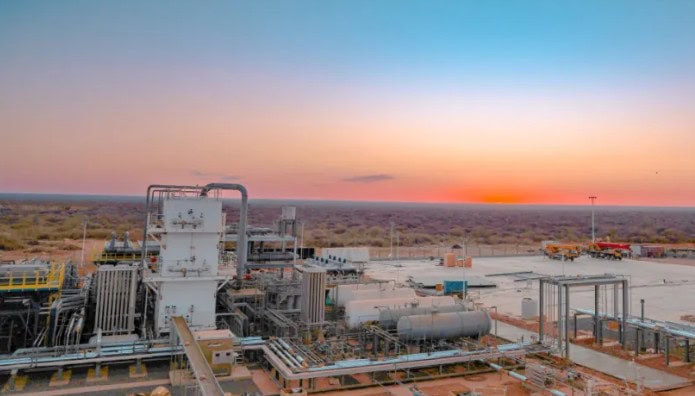
According to the lively GCL press release, the first 200,000-cubic-meter skid-mounted LNG plant in Ethiopia was officially commissioned on 2 October at Calub Camp, witnessed by Prime Minister Abiy and GCL Chairman Zhu Gongshan. It is a flagship energy project of China’s Belt and Road Initiative. GCL reports that the equipment was humming and “dozens of LNG tank containers – fully ready for departure – line up in a neat formation”.
The S&P Global article cites Prime Minister Abiy Ahmed that Ogaden liquefied natural gas (LNG) project in Calub will have annual production capacity of 111m litres/year, which will expand in future to 1.33bn litres/year.
The project broke ground in July 2024. Using modular skid-mounted technology significantly shortens the construction period and enables efficient low-temperature liquefaction of the Ogaden Basin’s abundant natural gas resources. The first phase can process 200,000 cubic meters of natural gas daily and produce 50,000 tons of LNG annually, supplying Ethiopian industrial parks and end-users.
The same day other large projects nearby also broke ground. These include natural gas power generation and oil refining as well as Phase II of GCL’s skid-mounted LNG liquefaction project which will supply LNG for export. The S&P Global article cites Prime Minister Abiy’s statement on X dated 2 October that GCL’s Gode oil refinery will process Ethiopian crude and condensate from the Hilala oil field in the Ogaden basin. The capacity is 3.5m metric tons/year (70,000 b/d), which could meet 70% of Ethiopia’s needs for fuel.
Nigeria’s Dangote Group is spearheading a joint venture between Dangote Industries (60%) and Ethiopian Investment Holdings (40%) to build a urea fertilizer plant with capacity of 3m mt/year. In March 2026, Dangote signed a $4.2bn agreement (see recent GCL announcement) for 25 years of natural gas to supply the plant, using gas to be sourced from the Calub gas field via a 108 km pipeline. The urea plant is expected to be online by 2029 and will cost $2.5bn.
Aliko Dangote, Dangote Group CEO, said the partnership reflects a broader strategy to deepen industrialization across Africa by building value chains that link natural resources directly to manufacturing: “Africa’s energy industry cannot continue exporting raw materials while importing finished products. Through strategic cooperation with GCL, we will create an efficient value chain from natural gas extraction to fertilizer production, strengthening Africa’s capacity to secure its own food supply.”
Chairman of GCL Group, Zhu Gongshan, described the agreement as a milestone for China–Africa industrial cooperation, noting that the partnership would combine GCL’s energy infrastructure expertise with Dangote’s manufacturing footprint across the continent.
2 responses
It’s a fascinating look at Ethiopia’s dual-track energy strategy—balancing massive fossil fuel infrastructure projects with its ambitious green goals.
Insightful summary of Ethiopia’s energy outlook. While the long-term domestic projects like the Calub and Hilala gas fields are game-changers for energy sovereignty, the current vulnerability to the Strait of Hormuz is a stark reminder of the risks of geographic concentration.
While Ethiopia’s strides to decarbonize transport (like the recent ban on non-electric passenger vehicles) are a worthy and innovative note in the regional energy transition, the immediate term remains precarious. To truly mitigate these “economic pains,” the country must look beyond the Gulf for fossil fuel imports to diversify supply chains before the 2029 domestic production targets are realized.
The $10bn transformation in the Somali region is a massive milestone, but the bridge to 2029 will require some creative diplomacy and trade diversification.
Thanks for sharing your insights, as always they are most valued. Yes, it will be interesting to see where else Ethiopia can look for fuel and other imports, this has been a big change when we have been accustomed to seeing the Middle East as so central to so much trade and commodities. I also found insightful the article published yesterday by the Institute for Foreign Affairs highlighting the Government’s emphasis on attracting investment into key infrastructure, particularly energy, as an enabler for future growth, another view of the physical side of the economic transformation that is also being built out in the markets.