
Morocco has officially launched its futures market and clearing house on 6 April 2026, after more than 10 years of preparation. All key stakeholders, the Ministry of Economy and Finance, Bank Al-Maghrib the regulator l’Autorité Marocaine du Marché des Capitaux (AMMC), the Bourse de Casablanca and market participants, supported the move, which brings the country closer to international standards,
Bourse de Casablanca operates both the futures market (Marché à Terme MAT, a 100% subsidiary) and the Central Counterparty clearing house (CCP) (owned 51% by Bourse de Casablanca, 49% by credit institutions)- see this exchange webpage.The website for the new futures market shows the current price for forward trades dated to July, September and December 2026 and March 2027.
A joint press release by the central bank and the capital market regulator on 6 April announced the launch of the institutional website www.icmat.ma of the Futures Market Coordination Body (l’Instance de coordination du marché à terme ICMAT).
ICMAT is established under the Futures Market Act (Law 42-12, drafted in 2012 and published in May 2015). It ensures coordination between the actions of the bank and regulator as they control the market jointly. It started being put into operation in 2019 after the implementing texts were adopted.
Trading MASI 20 futures
The first instrument for trading on the MAT is a cash-settled futures contract on the MASI.20 index, which covers the 20 top listed companies. The MAT will launch more contracts, including interest rates, in future.
According to an article on The Trade website Nasser Seddiqi, chief executive of Bourse de Casablanca, said: “This is a historic moment for Morocco. We are not merely launching new instruments, but an entirely new market equipped with world-class infrastructure that will strengthen the resilience and competitiveness of our economy.
“By providing investors – whether fund managers, institutional players, or retail participants – with effective hedging tools, we are firmly anchoring Casablanca as a leading regional financial hub”.
Morocco already has active equity markets on the Casablanca exchange, the addition of futures trading will enhance risk management and liquidity.
According to a story on African Markets: “a futures market allows investors to buy or sell an asset at a predetermined price for settlement at a future date. It serves three main purposes: hedging against risks, investing with leverage, and arbitraging price differences.” Trading and managing risks include a system based on margin deposits and daily adjustments.
A central counterparty (CCP) clearing house strongly reduces market, liquidity, counterpart and other risks. It acts as an intermediary, buying from the sellers and selling to the buyers. It uses a framework of guarantees and margin calls aligned with international best practices.
The futures market is expected to be used mostly by institutional investors – banks, insurance companies and funds – in the initial phase, helping them manage their risk exposures. In future the futures market could support the development of financial products, such as ETFs and structured products, that are more accessible to general investors, in the process broadening access to these instruments.
The Derivative Market Management Company (Société Gestionnaire du Marché à Terme, SGMAT) in early April issued a notice on the admission of trading members: Attijariwafa Bank, Bank of Africa, BMCE Capital Bourse, CDG Capital and CDG Capital Bourse, followed by a notice on Attijari Intermediation. It will also structure and approve by the newly created Derivatives Management Company.
There may have been a false start last May 2025 when the AMMC had announced that derivatives trading was active and the MASI.20 future was live on the Bourse, according to this story on Bloomberg.
A summary of the law written in 2013 in Oxford Business Group says it divides derivatives in three categories: futures, options and swaps. The Ministry of Finance must approve any institutions (banks and financial companies) that wish to carry out derivatives trading and the issuer of underlying assets must also consent. A prospectus and standard agreements must be prepared and counterparties must pay deposits to the clearing house, which maintains a guarantee fund.
The Bourse de Casablanca was launched in 1929 and relaunched as a private institution in 1993, before being demutualized in November 2015. It is moving to an integrated group covering three pillars: spot market, futures market and clearing. Mr Seddiqi was previously president of ICMAT from 2022-2025. He took over as DG of the Bourse in January 2026, according to this announcement by Casablanca Stock Exchange.
The move boosts Casablanca’s attraction as a financial centre.
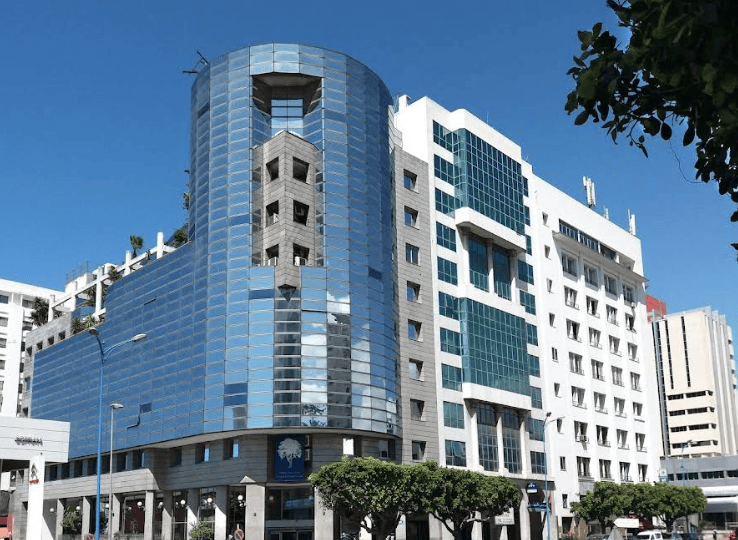
Photo: Headquarters of the Bourse de Casablanca, by DEMETERE own work, creative commons licence CC BY 4.0, from Wikipedia website.