
Africa’s securities exchanges have been climbing sharply in 2025 and still in 2026. Although this article is delayed, it’s interesting to delve into what is driving this outperformance.
Share prices on most African exchanges have soared for local investors, while the strong performance of many currencies against the US dollar have made investors who count gains in USD are also happy. The performance in the six months to 30 June 2026 carried on and sometimes accelerated the strong momentum of 2025 (see our article on 2025 performance here on ACMN).
Higher share prices make it attractive for growing African companies to raise capital on the exchanges, because they get better value for the shares they sell to the public. The trend for more initial public offerings (IPOs), listings by introduction and other capital raising through share sales started in 2025 and continues in 2026.
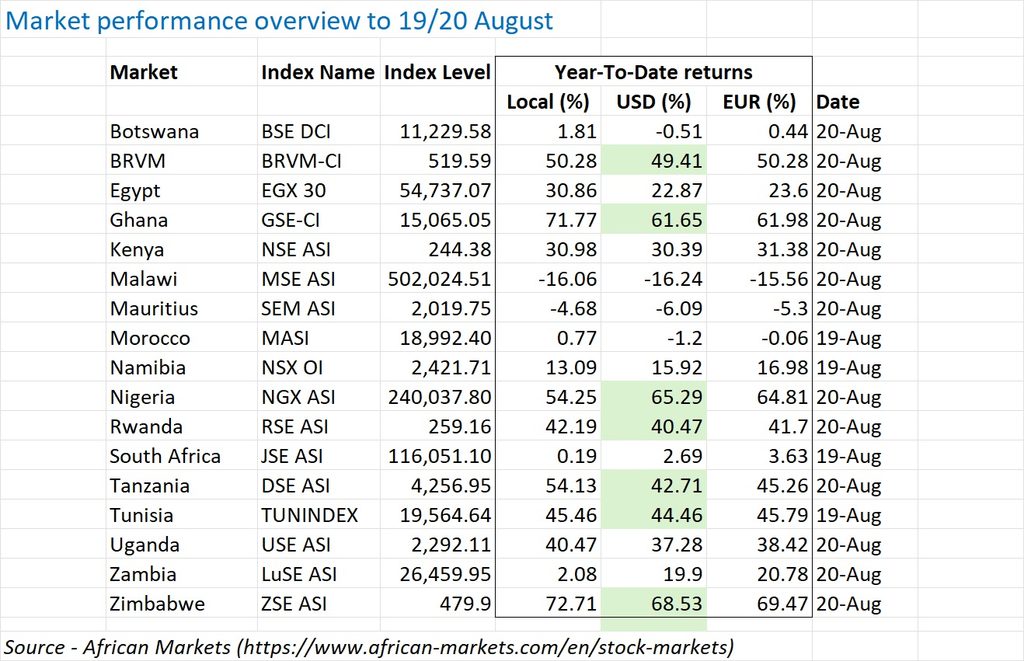
Update – 30 June to this week
Zimbabwe Stock Exchange All Share Index is up 68.5% year to date to USD investors and 72.7% for local investors, despite several key stocks migrating to the USD-denominated Victoria Falls Stock Exchange (see previous ACMN article).
The Ghana Stock Exchange Composite Index is up 61.7% for USD investors and 71.8% for local investors.
The Nigerian Exchange NGX All Share Index is up 65.3% for USD investors, and 54.3% for local investors. The Nigerian naira NGN has continued to recover this year. We looked into the effect of economic reforms in driving the Nigerian market higher in our January ACMN article when the market capitalization passed NGN 100 trillion ($71.5bn).
The BRVM yesterday (20 August) crossed XOF 20 trillion ($35.8bn) market capitalization after the index soared 50.3% for XOF and EUR investors and 49.4% for USD investors.
Bourse de Tunisie’s TUNINDEX is up 44.5% for USD investors and 45.5% for USD investors and Dar es Salaam Stock Exchange All Share Index is up 42.7% for USD investors and 54.1% for Tanzania shilling (TZS) investors.
Stock exchange indices year to date, see websites such as African Markets https://www.african-markets.com/en/stock-markets.
Key trends turbocharging Africa’s dynamic exchanges
African markets gains are well diversified across banks, oil and gas and climbing profits for consumer goods and manufacturing, offering good diversification. This compares to global markets, including emerging markets such as South Korea, which soared in the first half (despite a reversal in March) fuelled by the sky-high profits and valuations of companies who depend on AI spending and expectations of future demand.
Economic reforms are bearing fruit in countries such as Ghana and Nigeria. Businesses and investors are more confident and profits are climbing, with huge scope for future growth. Gains are spread across good companies in a wide range of sectors.
As markets become more liquid and better priced they may be upgraded on international indices, which can attract large flows of international capital where portfolios are modelled on the indices.
Strong investment returns boost the incentive for local institutional investors, particularly giant pension and insurance funds, to focus attention towards the equity markets and away from government bonds and treasury bills.
Top 10 exchanges to 30 June
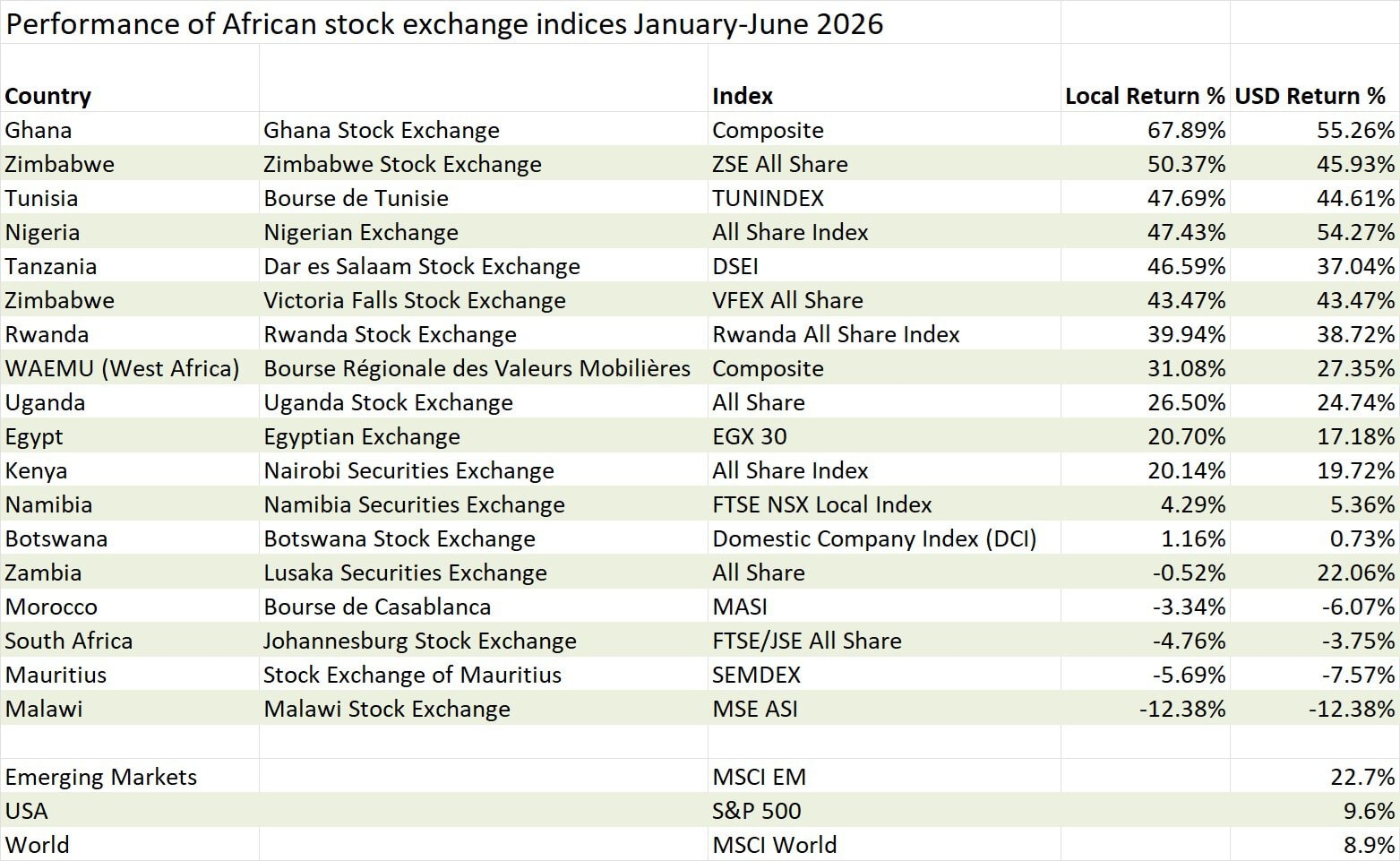
For our own detailed analysis to 30 June (see chart at top of page), we measured performance on 18 African equity markets, using either their main index or the domestic companies index for Namibia and Botswana. We used the index as a proxy for returns to local currency investors (they usually exclude dividends and any dealing costs), we also adjusted for changes in the exchange rate for local currency, to give results to investors who count returns in US dollars.
The exchanges are ranked by returns to local currency investors.
#1 Ghana Stock Exchange
For the first half of 2026, Ghana Stock Exchange Composite Index was top ranked on both measures, rising 67.9% for domestic investors and 55.3% for investors counting gains in US dollars. In 2025, the GSE-CI index climbed 79.4% for local currency investors, and a strong 40% recovery in the cedi-USD exchange rate meant a 154.4% gain for USD investors. So far in 2026 the currency has dipped but not enough to hold back the returns.
This performance signals investor confidence in better macro-economic management. Inflation is down sharply and previously sky high yields on government treasury bills and bonds are also down, encouraging institutional investors to switch into equities. Leading companies in the share price rally have been banks, insurance and telecommunications, including GCB Bank, MTN Ghana, Access Bank Ghana and Enterprise Group.
#2 Zimbabwe Stock Exchange, #6 Victoria Falls Stock Exchange (VFEX)
Zimbabwe has two main exchanges, both part of the same group: the growing “offshore” Victoria Falls Exchange (VFEX) which trades in USD and the ZSE which trades equities and bonds in the Zimbabwe Gold (ZWG) currency introduced in 2024.
The ZSE All Share rose 50.4% in local currency and 45.9% in dollars, while the VFEX All Share advanced 43.5%. Last year the ZSE was up 27.7% in ZWG and 26.8% in USD, while the VFEX soared by 70.2%.
The index gains were front-loaded on the ZSE, with a 31% gain in the ZSE All-Share Index by 20 January. Broker IH Securities warned this was narrowly focused. Delta Corporation, which manufactures and distributes beverages, makes up some 41% of the ZSE market capitalisation (total value of listed shares).
The second biggest stock by market capitalisation on the ZSE was Econet Wireless, which climbed in the early months. However it moved from the ZSE and listed on the VFEX on 27 March, taking trading liquidity with it. It listed at 30.10 US cents, but has since slipped back to 22.94 US cents by 30 June.
#3 Bourse de Tunisie
Bourse de Tunisie’s TUNINDEX gained 47.7% locally and 44.6% in dollars, following gains of 35.1% for dinar-based investors and 49.2% for USD-based investors in 2025. The rally is spread throughout the six months and has picked up momentum in the first weeks of July.
Brokers attribute the first half gains to a mix of falling interest rates and inflation, better corporate results at the end of 2025 and rising dividends, as well as increased trading activity and liquidity. In June, website Tustex described higher banking income at state-controlled Banque Nationale Agricole (BNA) and Banque de Tunisie, improved profits at SOTUMAG (general retail and agricultural wholesale) and SOTUVER (container glass), and a dividend announcement from chemicals firm ICF.
#4 Nigerian Exchange
In 2025, the Nigerian Exchange (NGX) All Share Index gave local investors a 51.2% return, and 60.6% return to USD investors. In the first half of 2026, it gave a 47.4% gain in naira and was ranked second in dollar returns, up 54.3%, as the naira continued to recover after dramatic falls in 2023 and 2024. The return was 60.5% year-to-date to 26 May, before the rally started to run out of steam in June.
The gains are built on economic reforms, higher oil prices and better supplies of foreign exchange. The price rally has been widely spread across nearly all sectors and share prices have more than doubled for leading counters such as Airtel Africa and Lafarge Africa, while a large range of counters are up by more than 50%.
S&P Dow Jones Indices has put Nigeria on a watchlist to be included in its Frontier Markets grouping in 2027.
#5 Dar es Salaam Stock Exchange
The Dar es Salaam Stock Exchange’s Index (DSEI) was up 46.6% for Tanzanian investors, but weakness in the shilling reduced the dollar return to 37.0%. Last year was also good, with returns of 29.1% for local investors and 27.5% for USD investors.
#7 Rwanda Stock Exchange
Seventh in the ranking by local returns was the Rwanda Stock Exchange with the Rwanda All Share Index up 39.9% measured in Rwanda francs and 38.7% in US dollars.
#8 Bourse Régionale des Valeurs Mobilières – BRVM
The BRVM Composite Index of the Bourse Régionale des Valeurs Mobilières which covers the eight countries of the Union Monétaire Ouest Africaine (UMOA) region in West Africa added 31.1% in CFA francs (XOF) and 27.4% in dollars.
#9 Uganda Securities Exchange
Uganda Securities Exchange gained 26.5% in shillings.
#10 Egyptian Exchange
The EGX-30 Index was up 20.7% in Egyptian pounds.
Hot on their tales
The Nairobi Securities Exchange All Share Index was up 20.1% for Kenyan investors, 19.7% for USD investors. Last year it returned 51.1% in local currency and 51.5% in USD returns.
Although the All Share Index of the Lusaka Securities Exchange declined by 0.5% for kwacha investors it was up 22.1% in US dollars, as the kwacha continued to climb. The LuSE had been another star performer in 2025, returning 67.9% to local investors and 111.7% to investors in USD. The equity and the currency markets signal approval of economic reforms.
Malawi Stock Exchange All Share Index was star performer in 2025, up 247.6% for local and 248.0% for USD investors. The market is distorted by the official peg of the kwacha exchange rate, and shares are typically a shelter when dramatic devaluation and inflation are feared – we looked into this in more depth in ACMN last October. In 2026 the MSE ASI is been the worst performer to June, down 12.4% for local and USD investors, using the official exchange rate.
Leading exchange indices reflect enthusiasm about economic reforms and increased domestic stability, while the US conflict in Iran boosted markets that export oil, where the increased wealth flows rapidly into banks and many other stocks.
For the long-term Africa optimists this is only the beginning. They point to the history of China and other Asian countries and see the signs of years of growth.
(A version of this article appeared previously in my regular column in African Banker magazine)
Top table – performance to 30 June of leading stock exchange indices, figures compiled by ACMN from various sources.